Keyword Gap Analysis: Find Content Ideas Faster
Keyword gap analysis shows which keywords a competitor ranks for and you don't. Here's how to run one, read the results, and turn them into content.
Keyword gap analysis compares your site against a competitor and lists the search terms they rank for that you do not. It is the fastest way to build a content plan from evidence instead of guesses, because every row is a topic where a similar site already earns traffic and you have no page at all. You can run one in a few minutes, and the hard part is reading the list well.
What a keyword gap actually is
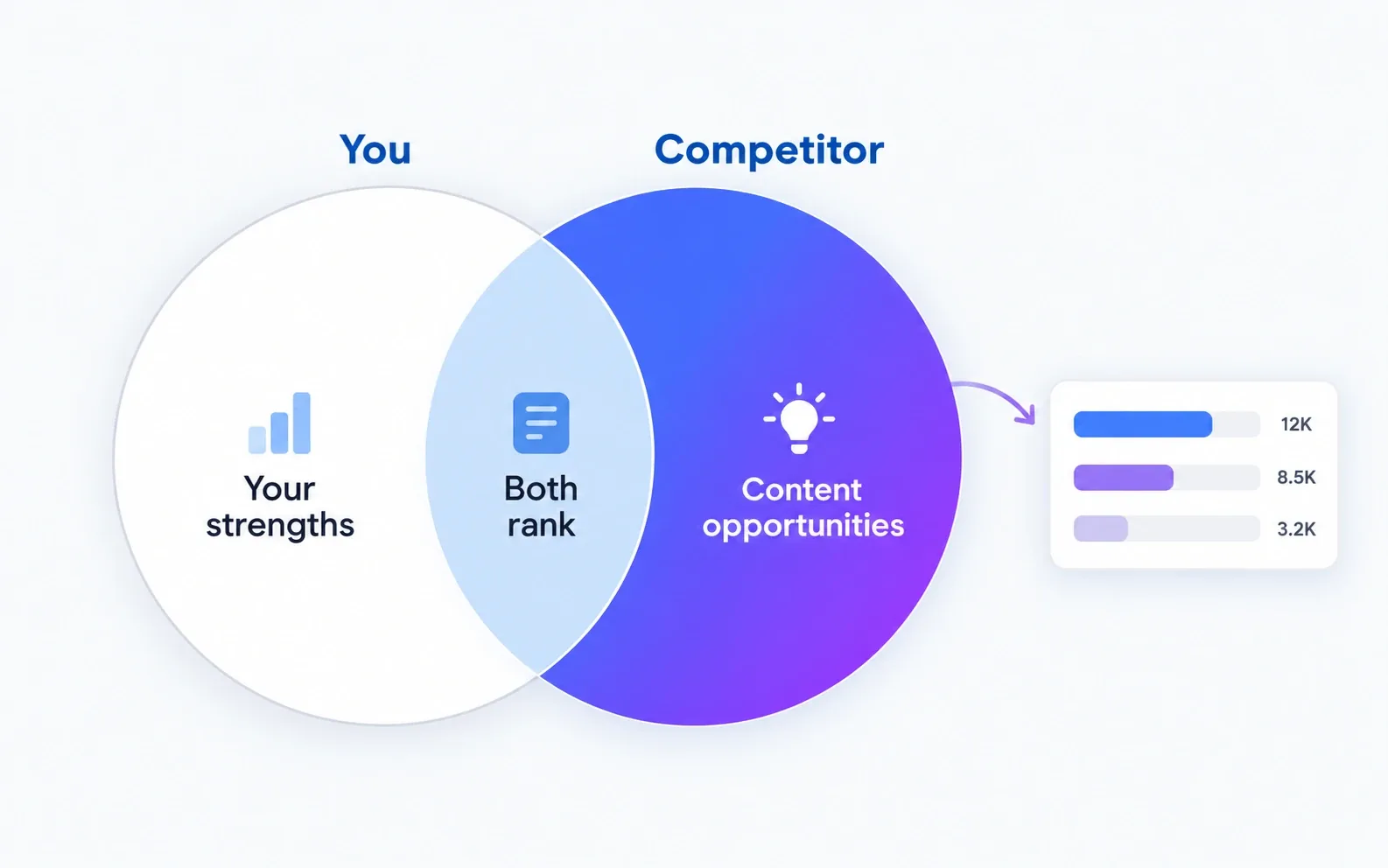
Take your domain and a rival’s domain. Pull the keywords each one ranks for in Google. The gap is the difference between the two lists. Most tools split it into three buckets, and each one answers a different question.
Keywords they rank for and you don’t are your content opportunities. These are the missing pages. Keywords you both rank for show where you are competing head to head, and where a better page could move you up. Keywords you rank for and they don’t are your strengths, worth protecting and worth building on.
The first bucket gets all the attention, but the second one is often quicker to act on. A keyword where you sit at position 14 and they sit at position 4 needs an improved page, not a new one.
Pick the right competitor first
A gap analysis is only as good as the rival you feed it. The mistake I see most is choosing the biggest name in the industry. Comparing a three-month-old site against a brand with fifteen years of links produces a list of thousands of keywords you cannot realistically win this year.
Pick a site that is a little ahead of you, not miles ahead. Similar size, similar topic, a few years older at most. Their rankings are evidence of what is achievable for a site like yours. If you are not sure who your real search competitors are, they are often not the businesses you compete with for customers. The sites that show up beside you in Google results for your target terms are the ones to check.
How to run a keyword gap analysis
You do not need a platform subscription for this. The steps are the same in any tool.
Enter your domain and one competitor. Choose the bucket you want, usually “they rank, you don’t” first. Sort by search volume so the biggest topics sit at the top. Then work down the list with a filter, which is where the judgment comes in.
In SearchCredits, the Competitor Research tool does this in two steps. Rival discovery costs 25 credits and suggests sites that overlap with yours in search. The keyword gap table for a chosen rival costs 10 credits, about $0.10. It shows your position, their position, monthly search volume, search intent, and the URL that ranks, with a switch between the three buckets and a CSV export. Seeing the exact page a competitor ranks with is often more useful than the keyword itself, because it tells you what format Google is rewarding.
How to read the list without drowning
A raw gap can run to thousands of rows. Four filters turn it into a plan.
Start with intent. A keyword that suggests someone wants to buy or compare (“alternative,” “pricing,” “best X for Y”) is worth more to most businesses than a purely informational one, even at lower volume. Mark those first.
Then look at volume against position. If a competitor ranks at 3 or 4 for a term with solid volume, that traffic is real and the page is beatable. If they rank at 40, it is noise.
Next, group the keywords into topics rather than treating each as its own post. Ten keywords that are all phrasing variations of the same question belong on one page. Gap lists are full of near-duplicates, and writing a separate post for each is how sites end up competing with themselves.
Last, check whether you already have a page that could rank. Search your own site for the topic before writing anything. Sometimes the gap exists because an existing page is thin or poorly titled, not because the topic is missing.
Turning the gap into a content plan
For each topic you decide to pursue, open the competitor URL and note what it is: a guide, a comparison table, a tool page, a list. Write something that covers the same ground and then goes further, whether that is more current numbers, a clearer structure, or a point of view they do not have. Copying their outline gets you a worse version of a page that already exists.
Aim for a batch of five to ten topics, ordered by a mix of intent and ease. Publish, then re-check in four to six weeks. If you are tracking positions for the new pages, a handful of targeted rank checks cost a couple of credits each and tell you quickly whether the page is moving.
Free ways to get a rough version
If you only want a feel for it before spending anything, you can approximate a gap by hand. Search your target topics and note which competitors keep showing up. Open their blog and category pages and list the topics you have not covered. Google Search Console shows what you already rank for, so you can see which of their topics you are missing. It is slower and has no volume numbers, but it works for a small site. My guide to keyword research without a subscription covers the free sources in more detail.
For a competitor-focused comparison of tools that do this at scale, the Semrush alternative roundup lists cheaper options, and the same ideas apply to any of them.
Frequently asked questions
What is keyword gap analysis?
It is a comparison of the keywords two websites rank for. The gap is the set of keywords a competitor ranks for that your site does not, which makes it a list of content topics already proven to bring search traffic to a similar site.
How do I do a keyword gap analysis for free?
Search your key topics and note which competitors appear, then browse their content for topics you have not covered. Use Google Search Console to see what you already rank for. It is manual and has no volume data, but it is workable for a small site.
How many competitors should I compare against?
Start with one that is slightly ahead of you in size and age. Comparing against several at once produces a list too long to act on. Run additional competitors one at a time once you have worked through the first.
What is the difference between a keyword gap and a content gap?
A keyword gap is the list of search terms a rival ranks for that you do not. A content gap is the broader question of which topics you have not covered. A keyword gap is the most measurable way to find a content gap, since it includes volume and ranking positions.
How often should I run a keyword gap analysis?
Every quarter is enough for most sites, or whenever you finish a batch of new content and want to find the next one. Competitors publish constantly, so a gap you closed in spring can reopen by autumn.