Semrush Alternative: 6 Cheaper Ways to Do the Same Research
Your best Semrush alternative depends which part of Semrush you use. Six cheaper options for keyword, competitor and audit research, and when each fits.
The best Semrush alternative depends on which part of Semrush you actually use. Semrush bundles SEO, paid search, content, social, local, and market research into one subscription that starts at $139 a month, or $117.33 when billed annually. Most people live in one or two of those areas. The cheaper path is to pick a tool for the part you use and stop paying for the rest.
The short version
If you want a similar all-in-one platform for less, SE Ranking is the closest match. If your work is mostly keyword and SERP research, Mangools or Moz Pro cover it at a lower entry price. If your usage comes in bursts, SearchCredits lets you pay per lookup instead of monthly. If you only touch Semrush a few times a month, Google’s free tools plus one paid check when you need real data will get you most of the way. SpyFu is the option to look at if competitor and ad research is the specific reason you were paying for Semrush.
There is no tool that gives you every Semrush report, the same data, and the same workflow for a fraction of the price. The useful question is not “which tool is Semrush but cheaper”, it is “which parts of Semrush do I open in a normal week”.
Semrush alternative comparison
| Option | Starting price | Best for | Main compromise |
|---|---|---|---|
| Semrush | $139/month, or $117.33 billed annually | Daily use across SEO, PPC and content | Expensive when you use one corner of it |
| SearchCredits | $1 buys 100 credits, no subscription | Pay-as-you-go keyword, competitor, audit, rank and AI checks | Not a full all-in-one dashboard |
| SE Ranking | Around $103/month for the entry plan | A like-for-like all-in-one at a lower price | The gap to Semrush has narrowed as its pricing rose |
| Mangools | Check the pricing page; the Basic plan has sat around $30-40/month | Keyword and SERP research with a gentle learning curve | Narrower than a full suite; often annual billing for the listed rate |
| Moz Pro | Starter has sat around $49/month | A conventional suite at a lower entry point | Standard tier roughly doubles the price |
| Google’s free tools | Free | Keyword ideas, your own performance, demand trends | No competitor database or backlink index |
| SpyFu | Check the pricing page; historically well below Semrush | Competitor keyword and ad intelligence | Focused on competitor and PPC research, not a full SEO suite |
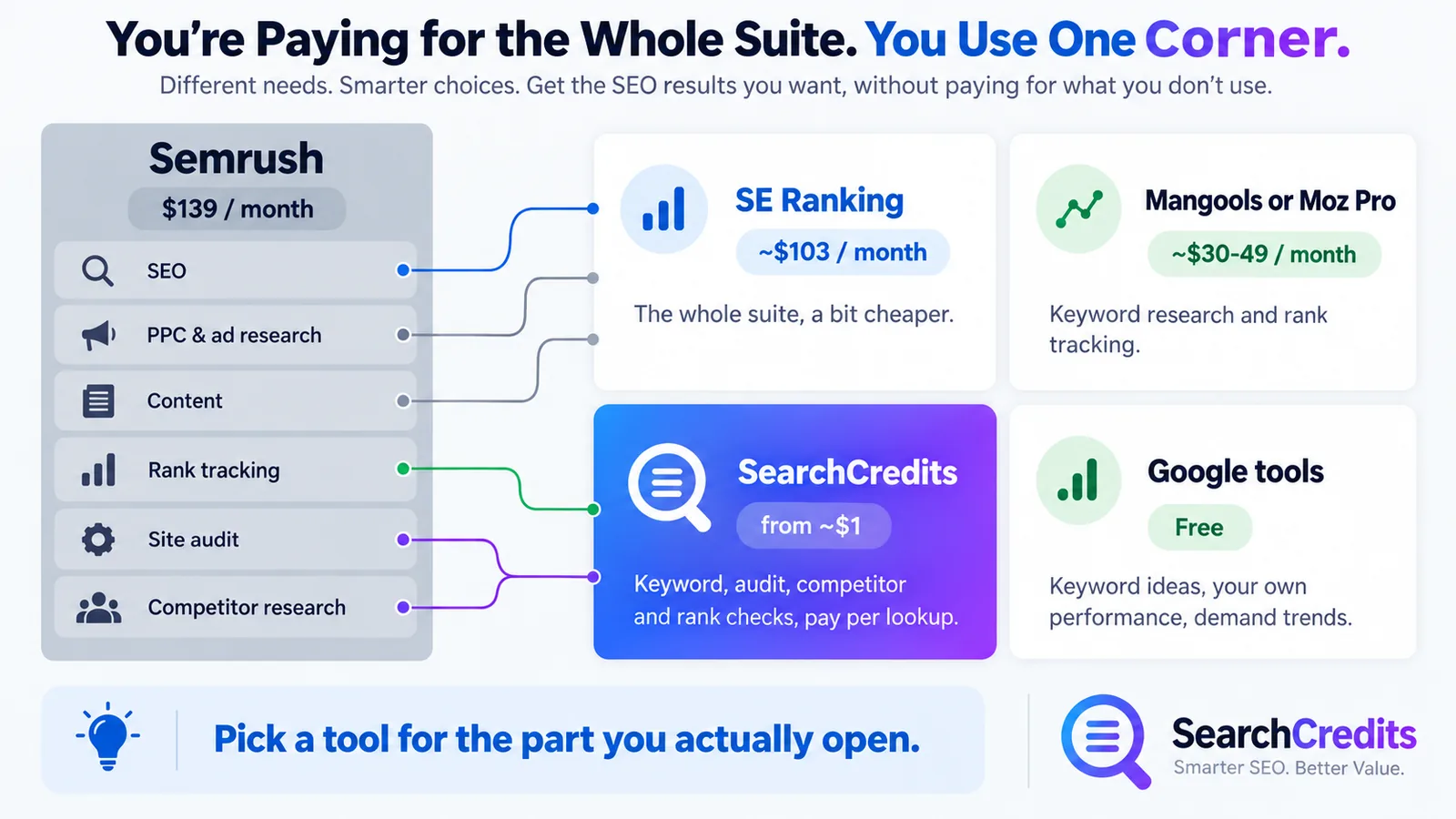
Semrush is a lot of tool
Semrush is comprehensive, and that is the point of it. Keyword research, rank tracking, site audits, backlink analysis, competitor research, PPC and ad research, content optimisation, social scheduling, local SEO, and market research all sit under one login. For an in-house team or an agency that uses most of that every day, the consolidation is worth the price.
The problem is fit. A freelancer who does keyword research for two client sites a month, or a founder checking their own rankings, pays the same $139 as an agency running audits across fifty domains. In a quiet month the subscription returns almost nothing.
Semrush has a free account with tight limits, worth trying before you pay for anything. Treat it as a preview, not a replacement.
If you are still working out what you actually need, my guide to keyword research without a subscription is a good place to start.
1. SearchCredits: pay per lookup instead of per month
I built SearchCredits for the case Semrush handles badly: people who need SEO data occasionally and resent paying for a month they barely used.
One dollar buys 100 credits, and each action shows its credit cost before you run it. Keyword research is 10 credits, about $0.10. A full-site audit is 20 credits. A competitor keyword gap is 10. New accounts start with free credits, and purchased credits last 12 months, so you can buy a batch and spend it across projects that land weeks apart.
The tools cover keyword research with volume, difficulty and intent, single-page and full-site audits, rank tracking you can schedule for client reports, competitor discovery and keyword gap analysis, AI visibility checks, shopping visibility, price monitoring, and local rank grids. The underlying data is aggregated from established third-party providers.
It does not try to be a Semrush dashboard. There is no PPC toolkit, no social scheduler, no content marketing platform. If your Semrush usage is really just the research features, that trade is easy. If you use half the platform daily, it is not.
2. SE Ranking: the closest like-for-like, cheaper
SE Ranking is the alternative that looks and works most like Semrush. It has rank tracking, keyword research, a site audit, competitor research, and backlink tools in one platform, and its entry plan runs around $103 a month.
That used to be a much bigger saving. SE Ranking’s pricing has climbed over the last couple of years, so the gap to Semrush’s annual rate is now smaller than it was. Check the current numbers on both pricing pages before you switch on price alone.
Pick SE Ranking if you genuinely want the whole suite in one place and just want to pay less for it. If you only use part of it, a narrower tool will cost less again.
3. Mangools: keyword and SERP research without the complexity
Mangools is a set of five connected tools, most notably KWFinder for keyword research and SERPWatcher for rank tracking, with a much gentler interface than a full platform. The Basic plan has historically sat around $30 to $40 a month, often on annual billing, so check the current rate and term.
It is a good fit for bloggers, affiliate site owners, and freelancers whose regular work is finding keywords and watching a set of rankings. You give up depth on backlinks and large-scale competitor analysis, which may not matter if that was never why you opened Semrush.
4. Moz Pro: a familiar suite at a lower entry point
Moz Pro is the traditional “pay monthly, get an SEO platform” option. Its Starter plan has sat around $49 a month, with Standard roughly double that.
Compare the limits, not just the headline price. A cheaper plan is no help if the report you need sits on a higher tier. Moz makes sense if you want a recognised suite with predictable billing and your usage is steady rather than bursty.
5. Google’s free tools: for the parts you touch occasionally
A lot of what people use Semrush for has a free equivalent from Google.
Keyword Planner gives keyword ideas and planning estimates, though it is built for advertisers, so its competition metric is about ad competition, not organic difficulty. Search Console shows the queries and pages you already rank for, which is the best data you have on your own site. Google Trends shows demand direction and seasonality. For a local business, a complete Google Business Profile does most of the local SEO work.
This stack does not do competitor research or backlinks. The small SEO tools guide covers how to combine the free layer with a paid check when the free tools cannot answer the question.
6. SpyFu: competitor and ad intelligence
If the reason you pay for Semrush is seeing what competitors rank for and what they bid on, SpyFu does that specific job. It shows a domain’s organic keywords, its paid keywords, its ad history, and its main rivals. Its pricing has historically run well below Semrush, so check the current plans.
SpyFu is not a full SEO suite. There is no serious site audit and the keyword database is smaller. As a focused competitor and PPC research tool at a lower price, it holds up.
What about Ahrefs?
Ahrefs is the other big all-in-one, and it is not a cheaper answer here. Its entry plan starts at $129 a month, close to Semrush. Choose between them on data and workflow, not price. If you are looking for genuinely cheaper options, my Ahrefs alternative comparison covers the same ground from the other direction, and most of the tools overlap.
How to choose without wasting money
List the Semrush reports you opened in the last 60 days. Use what you actually ran, not what you meant to.
If that list spans daily rank tracking, backlink monitoring, PPC research, and content briefs, a full suite probably earns its price, and SE Ranking is the cheaper version of that.
If it is a few keyword batches, one site audit, and occasional competitor checks, a pay-as-you-go tool or a narrower subscription will cost far less. If most of your work is improving pages you already have, Search Console and Trends cover more than you would expect.
Factor in switching cost too. Stitching together three cheap tools saves money but costs time. Paying for a large suite “in case” is not efficient if you only ever open one report.
Frequently asked questions
Is there a free Semrush alternative?
No single free tool replaces the whole platform. Google Keyword Planner, Search Console, and Google Trends cover keyword ideas, your own performance, and demand trends between them. Semrush’s own free account works as a limited preview. None of these do competitor keyword databases or backlinks.
What is the cheapest Semrush alternative?
For a full suite, Mangools or Moz Pro at a lower entry price, or SE Ranking if you want the closest match. For occasional use, SearchCredits at a few cents per lookup with no subscription is usually the cheapest overall, because you only pay in the months you do research.
What is the best Semrush alternative for freelancers?
It depends on cadence. For steady weekly client work, Mangools or Moz Pro are easy to budget. For irregular project work, pay-as-you-go through SearchCredits avoids paying for quiet months. My post on SEO tools for freelancers goes through the trade-off.
Is Semrush worth it?
It can be, if you use several of its toolkits most working days. It is hard to justify if you log in a few times a month for keyword research or a competitor check, since you pay the full price either way.
Which alternative is closest to Semrush?
SE Ranking, in shape and feature coverage. Ahrefs and Moz Pro are also full suites but differ in data and layout. No alternative matches Semrush report for report, so compare the specific features you use rather than assuming parity.