AI Citation Gap Analysis: Who AI Cites Instead of You
AI citation gap analysis shows which websites AI answers cite for your topic and where you rank among them. Here's how to run one and act on it.
AI citation gap analysis answers one question: for the topics your customers ask AI assistants about, which websites do the answers cite, and where do you sit in that list? The sites at the top are shaping what the AI tells people, and if you are not among them, they are your gap. It is the AI-search version of a keyword gap, and it gives you a concrete list of places to get mentioned instead of a vague instruction to “improve your AI visibility.”
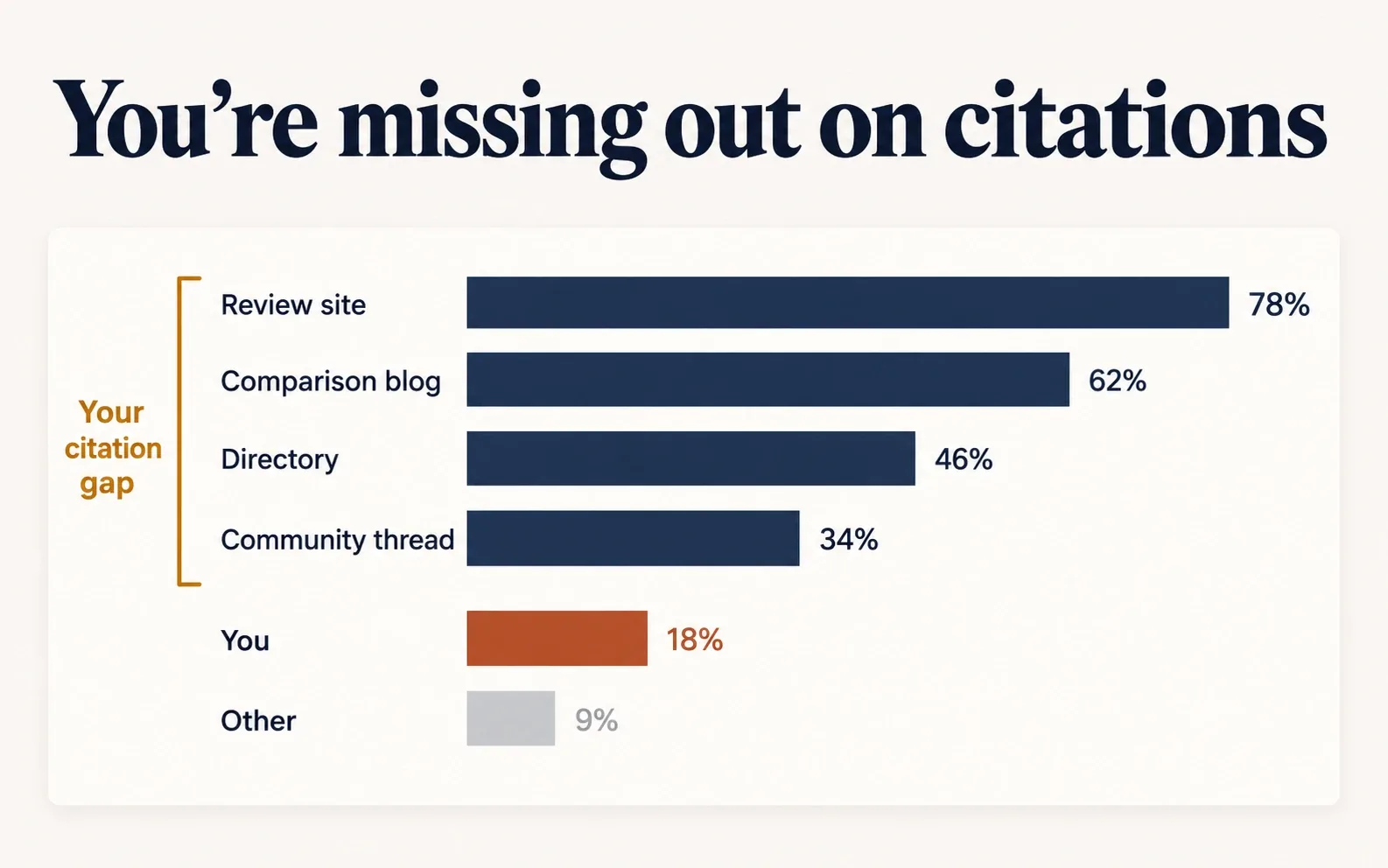
Illustrative example. The percentages are made up to show the shape of a citation gap, not real data.
Mentions and citations are different things
A mention is when an AI answer names your brand in its text. A citation is when the answer links to your website as one of its sources. You can get one without the other. An assistant might recommend three competitors by name and cite a review site that ranks them, with your brand absent from both.
Citations matter because they show where the answer came from. Google’s own guidance on AI features describes AI answers as including links to supporting pages. If a handful of domains keep appearing as those supporting pages for your topic, the answer is leaning on them. My broader guide to AI visibility covers the mention side, and this post is about the sources behind it.
What a citation gap looks like
Pick a topic a buyer in your market would ask about, for example “best accounting software for freelancers.” Ask an AI assistant and look at the sources it links. Do that across a few related questions and you will see the same domains again and again: a couple of review sites, a comparison blog, perhaps a community thread, a few vendor sites.
That repeated list is the leaderboard. Your citation gap is every domain above you on it, or all of them if you do not appear at all. The useful part is that it points at specific pages you can act on, not at a score.
How to run one by hand
You can do a rough version for free. Write down five to ten questions a real customer would ask about your category, phrased the way people talk. Run each one through ChatGPT, Google’s AI results and any other assistant your audience uses. For each answer, note every site it cites. Put the results in a spreadsheet and count how many times each domain appears.
It works, but it has two limits. AI answers vary from one run to the next, so a small sample is noisy. And counting citations across dozens of answers by hand takes hours. If you only want to know whether a topic is worth pursuing, it is enough. For anything you will act on, you want a bigger sample.
Running it with a tool
The citation gap check in SearchCredits’ AI Visibility tool does the counting for you. You enter a topic, and it returns a ranked list of the domains cited most often in AI answers for that topic, with the number of mentions behind each one. If you have a domain entered, your own site is flagged in the list, and the page tells you where you rank or that you are not cited at all. You can export the list to CSV. It costs 35 credits, about $0.35, per topic.
Because each check is a single topic, pick topics deliberately. Choose the questions closest to a purchase, such as “best X for Y” and “X alternatives,” over broad educational ones. Three to five topics covers most businesses, which is roughly $1 to $2 in credits.
How to read the leaderboard
Group the domains by what they are before you decide what to do. They usually fall into a few types.
Review and comparison sites that rank products in your category are the most valuable. Getting listed or reviewed there puts you directly in front of the answer. Editorial and publisher sites that run roundups behave the same way. Community sites such as forums and discussion threads tend to appear on questions where people want real opinions, and the way in is taking part honestly, not posting links. Competitor sites that show up are citing their own pages, which tells you which of their pages the AI treats as the reference for the topic. Directories and listing sites are often the easiest to get into.
Then look at where you are. If you are cited but low, one strong page on the topic may be enough to move up. If you are absent, the question becomes why no page of yours gets used as a source, which usually means you have no page that clearly answers that question.
What to do with the gap
Start with the sources you can influence directly. Submit your product to the directories and comparison sites on the list. Contact the editors of the roundups and ask whether your product fits, with a clear reason it does. This is ordinary outreach, and the leaderboard gives you a prioritized target list instead of guessing.
Next, read the pages the AI cites, especially competitor pages. Note how they answer the question: whether it is a comparison table, a definition up front, a step-by-step guide. Publish a page on your own site that answers the same question more clearly and with more current detail. A page that states the answer in its opening lines and backs it with specifics is easier for an assistant to cite than one that circles the point.
Finally, repeat the check. AI answers shift as models and sources change, so rerun your topics every month or two and see whether you have moved up the list. It is the same discipline as a keyword gap analysis, pointed at a different kind of search result.
If you are still working out how to test whether AI assistants name your brand in the first place, my guide on checking whether ChatGPT mentions your brand is the place to start.
Frequently asked questions
What is an AI citation gap?
It is the set of websites that AI answers cite for a topic where your own site is not cited, or is cited less often. Each domain above you on the list is part of the gap, and each one is a possible place to get mentioned or a page to learn from.
How is an AI citation different from an AI mention?
A mention is your brand named in the answer text. A citation is a link to your website as a source for the answer. A brand can be mentioned without being cited, and a site can be cited without the brand being named.
Can I do an AI citation analysis for free?
Yes, manually. Ask an assistant five to ten questions about your category, record every site it cites, and count how often each domain appears. It is slow and noisy because answers vary, but it is enough to judge whether a topic is worth pursuing.
How many topics should I check?
Three to five topics that are close to a buying decision is a good start for most businesses. Choose questions like “best X for Y” or “X alternatives” over broad educational questions, since those are where a citation is most likely to lead to a customer.
How often should I rerun a citation gap check?
Every month or two is enough for most topics. AI answers and the sources they use change over time, so a check is a snapshot, and the useful signal is whether you are moving up the list across several checks.