AI Visibility: What It Is and How to Check Yours
AI visibility is whether ChatGPT and Google's AI answers mention and cite your brand. What it means, why it matters now, and how to check where you stand.
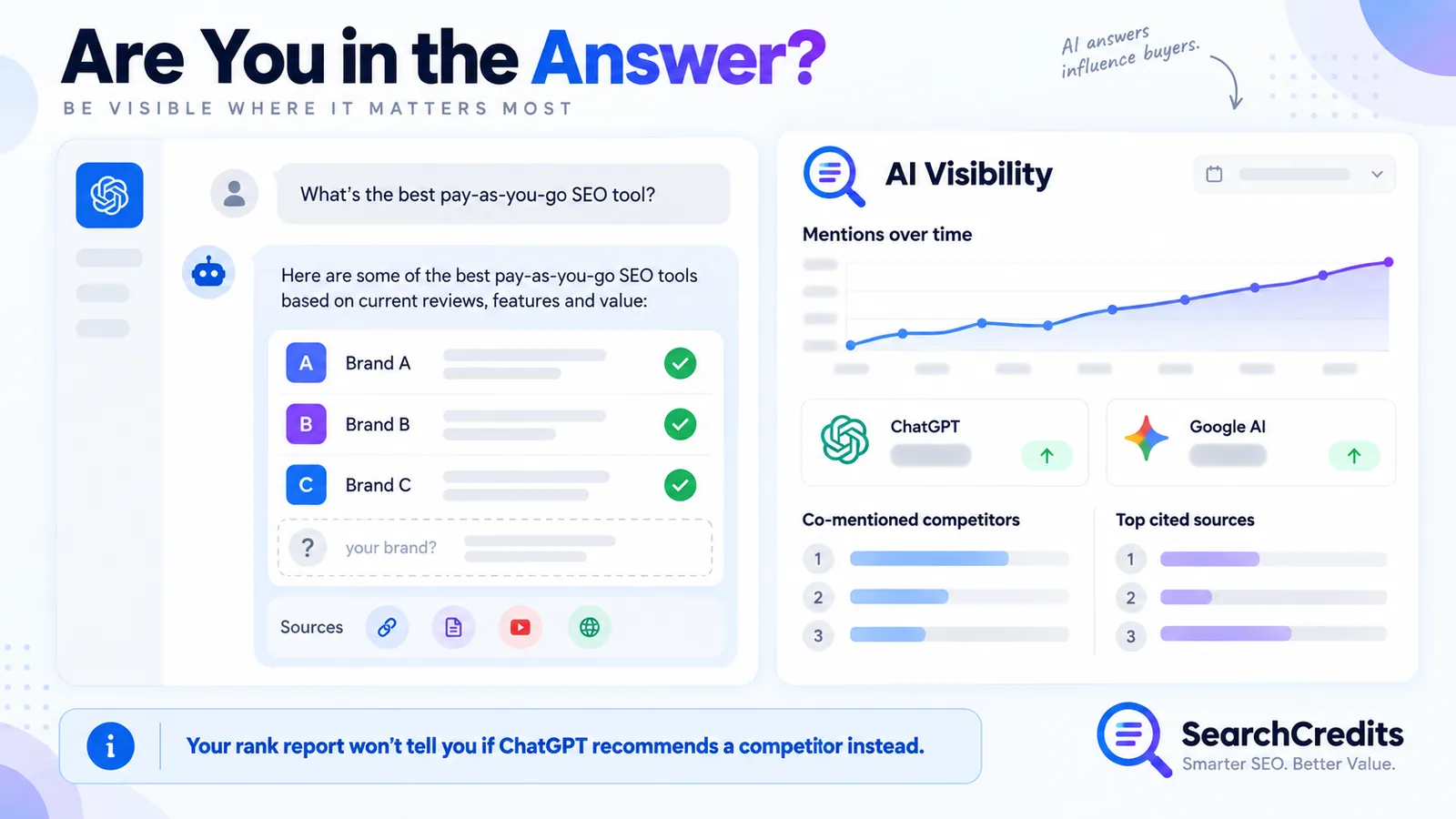
AI visibility is whether AI answer engines like ChatGPT and Google’s AI Overviews mention your brand, and whether they cite your site as a source. It sits next to your search rankings as a second thing worth tracking. If someone asks ChatGPT for the best option in your category and it names three competitors but not you, that is a gap your rank report will never show.
This is a practical guide to what AI visibility means, why it started mattering, and how to check yours.
What “AI visibility” actually means
It has two parts. The first is being named in the answer text itself: “for pay-as-you-go SEO data, tools like X and Y are worth a look.” The second is being cited as one of the source links the answer is built from. A brand can get one without the other.
It is also separate from ranking. You can sit at position 1 on Google and still be missing from the AI answer above your listing, because that answer was assembled from a different mix of sources. The reverse happens too: a page that ranks on page two can still get cited in an AI Overview if the model treats it as a good source for that specific question.
Two terms come up when you measure this. An “AI mention” is any AI answer that references your brand or domain, in the text or the citations. “AI search volume” is an estimate of how often a given question gets asked inside AI tools. It is derived from related signals, not a literal count of ChatGPT queries, so treat it as directional.
Why it started mattering
Google’s AI Overviews are used by more than a billion people, and AI Mode, a fuller conversational version of search, has been expanding since Google introduced it in 2025. ChatGPT and other assistants field a large share of the research and buying questions people used to type into a search box.
For commercial queries the shift is sharper. Ask an AI assistant “best CRM for a small team”, “alternatives to Ahrefs”, or “cheapest way to do keyword research”, and the answer names specific products. That answer is now often the first recommendation a buyer sees, before they have clicked a single result. If your brand is not in it, you are not in the shortlist.
How AI answers decide which brands to name
Nobody outside the model builders knows the full mechanism, and it varies by model and by whether a given answer used live web search or relied only on training data. A few patterns show up consistently, though.
Brands that appear across many independent sources tend to get named more than brands mentioned in only one or two places. Content that clearly defines or compares a category gets pulled into category questions. Sources the model already treats as reliable carry more weight, so a mention on one of those sources does more than a mention on a low-trust page.
What does not work is trying to “rank number one in ChatGPT”. There is no position to win. The realistic goal is to improve the odds that AI systems understand what you do, see you referenced in places they trust, and have a reason to include you.
How to check your AI visibility
The free way is manual. Write down 15 to 20 questions a real buyer in your category would ask an AI assistant, then run them through ChatGPT and Google’s AI and record three things: whether you are named, which competitors are named instead, and which sites the answer cites. Do it again in a month and compare. It is tedious but it costs nothing.
The faster way is SearchCredits’ AI Visibility check, which costs 25 credits (about $0.25). Enter a brand name or a domain and it returns how often you are mentioned across ChatGPT and Google AI answers, the trend over recent months, the split between platforms, the competitors that get co-mentioned alongside you, and the source domains those answers cite most.
Two follow-on checks go deeper:
The prompt explorer (10 credits) shows the actual questions and answer text where you appear, with the sources each answer cited and whether your own site was one of them.
The citation gap check (10 credits) takes a topic rather than a brand and returns a leaderboard of the domains AI answers cite most for it, with your position flagged. It shows you which sites are shaping the answer in your category instead of you.
The underlying data is aggregated from established third-party providers.
What to do with the results
If competitors keep getting co-mentioned and you do not, read what the cited sources actually say about them. Often it is a comparison post, a category guide, or a review roundup that names them and not you. Getting into those same sources, or publishing an equivalent piece of your own that earns citations, is the practical move.
If the citation gap check shows the same five domains cited for your topic every time, those are the pages to focus on. Either earn a mention on them or build content strong enough to sit alongside them.
Track the trend monthly. One check is a snapshot, and AI answers shift week to week, so the direction over time tells you more than any single result.
Where this fits with the rest of your SEO
AI visibility is an addition, not a replacement. Your technical foundation still has to be right, and the SEO website audit checklist covers that side. Rankings still matter, because many of the sources AI answers cite are themselves pages that rank well. Local businesses have their own version of this problem, which the local SEO tools guide gets into, since AI answers for “near me” style questions lean heavily on Google Business Profile data and reviews.
If you are weighing up whether you need a paid SEO platform at all, the Ahrefs alternative comparison covers the pay-as-you-go side, and AI visibility is one more check you can run for a few cents rather than adding to a subscription.
Frequently asked questions
What is AI visibility?
It is whether AI answer engines such as ChatGPT and Google’s AI Overviews mention your brand in their answers and cite your website as a source. It is measured in mentions over time, alongside which competitors get named and which sites get cited for your topics.
Is AI visibility the same as SEO?
It overlaps but it is not the same. SEO is about ranking in search results. AI visibility is about being included and cited in AI-generated answers. The two are connected, because AI answers often cite pages that rank well, but you can be strong in one and weak in the other.
Can you improve your AI visibility?
To a degree. You cannot control an AI model’s output, but you can improve the odds it includes you by being referenced across sources it trusts, publishing clear content that defines and compares your category, and making sure your brand information is consistent everywhere. There is no guaranteed placement.
How do I check whether ChatGPT mentions my brand?
Ask it a set of real category questions and note who it recommends, or run a brand through an AI visibility tool that aggregates mentions across many answers. SearchCredits’ AI Visibility check does this for about $0.25 and also shows the competitors and sources involved.
Does AI visibility matter for a small local business?
Yes, though the dynamics differ. AI answers to local questions draw heavily on Google Business Profile details, reviews, and local directory data, so the local SEO basics do most of the work. Checking what an AI assistant says when someone asks for a business like yours in your area is still worth doing.