Ahrefs Alternative: 7 Cheaper Ways to Do Keyword Research
A blunt look at Ahrefs alternatives for people who don't need a $129/month subscription — what you give up, what you don't, and when each makes sense.
The best Ahrefs alternative depends on how often you actually use SEO data. If keyword research, backlink analysis, and competitor monitoring are daily work, Ahrefs can justify its $129/month starting price. If you only need those answers a few times a month, paying for permanent access is usually unnecessary.
The short answer: which Ahrefs alternative should you choose?
Here is my blunt recommendation:
- Use Ahrefs if SEO is central to your job and you work inside the platform most days.
- Use SearchCredits if your usage is irregular and you would rather pay for specific actions than keep another subscription running.
- Use Moz Pro Starter if you want a conventional SEO suite at a lower monthly entry price.
- Use Mangools if you want approachable keyword and SERP tools without enterprise-level complexity.
- Use LowFruits if your main job is finding lower-competition keywords.
- Use Google Keyword Planner for advertising-oriented keyword estimates and ideas.
- Use Google Search Console for queries where your site already receives impressions.
- Use Google Trends to compare relative demand, seasonality, and regional interest.
There is no universal replacement that gives you every Ahrefs feature, the same data, and the same workflow for a fraction of the price. The useful question is not “Which tool is Ahrefs, but cheaper?” It is “Which parts of Ahrefs do I genuinely use?”
Ahrefs alternative comparison
| Option | Official price | Best for | Main compromise |
|---|---|---|---|
| Ahrefs | From $129/month | Heavy, daily SEO work | Expensive when used occasionally |
| SearchCredits | $1 buys 100 credits; optional $9/month membership | Pay-as-you-go research, audits, tracking, and visibility checks | Not designed to reproduce every Ahrefs workflow |
| Moz Pro Starter | $49/month | A lower-cost traditional SEO suite | Standard rises to $99/month |
| Mangools Basic | $37.70/month billed annually | Straightforward keyword and SERP research | Annual billing for the listed rate |
| LowFruits | $25 for 2,000 pay-as-you-go credits or $29.90/month | Finding lower-competition keyword opportunities | More specialized than a full SEO platform |
| Google Keyword Planner | Free tool within Google Ads | Keyword ideas and paid-search planning | SEO competition is not the same as ad competition |
| Google Search Console | Free | Queries and pages already visible in Google | Not a competitor-research database |
| Google Trends | Free | Seasonality and relative interest | Relative trends, not conventional keyword volumes |
First, Ahrefs is good at what it does
I am not going to trash Ahrefs to make another tool look better. Ahrefs combines keyword research, competitor analysis, backlink data, content discovery, rank tracking, and site auditing in one mature product. That consolidation matters when you use several of those functions every day.
The problem is fit, not quality. A freelance writer who researches two sites a month has different economics from an SEO agency checking dozens of domains every morning. The freelancer can pay $129 in a quiet month and receive almost no value from the subscription.
Ahrefs also offers a limited free account, which is worth checking before paying. Just treat it as a limited entry point rather than assuming it replaces the paid platform.
If you are still deciding what you actually need, start with my guide to keyword research without a subscription.
1. SearchCredits: best for irregular SEO work
I built SearchCredits around a simple frustration: many people need SEO tools, but they do not need them every day.
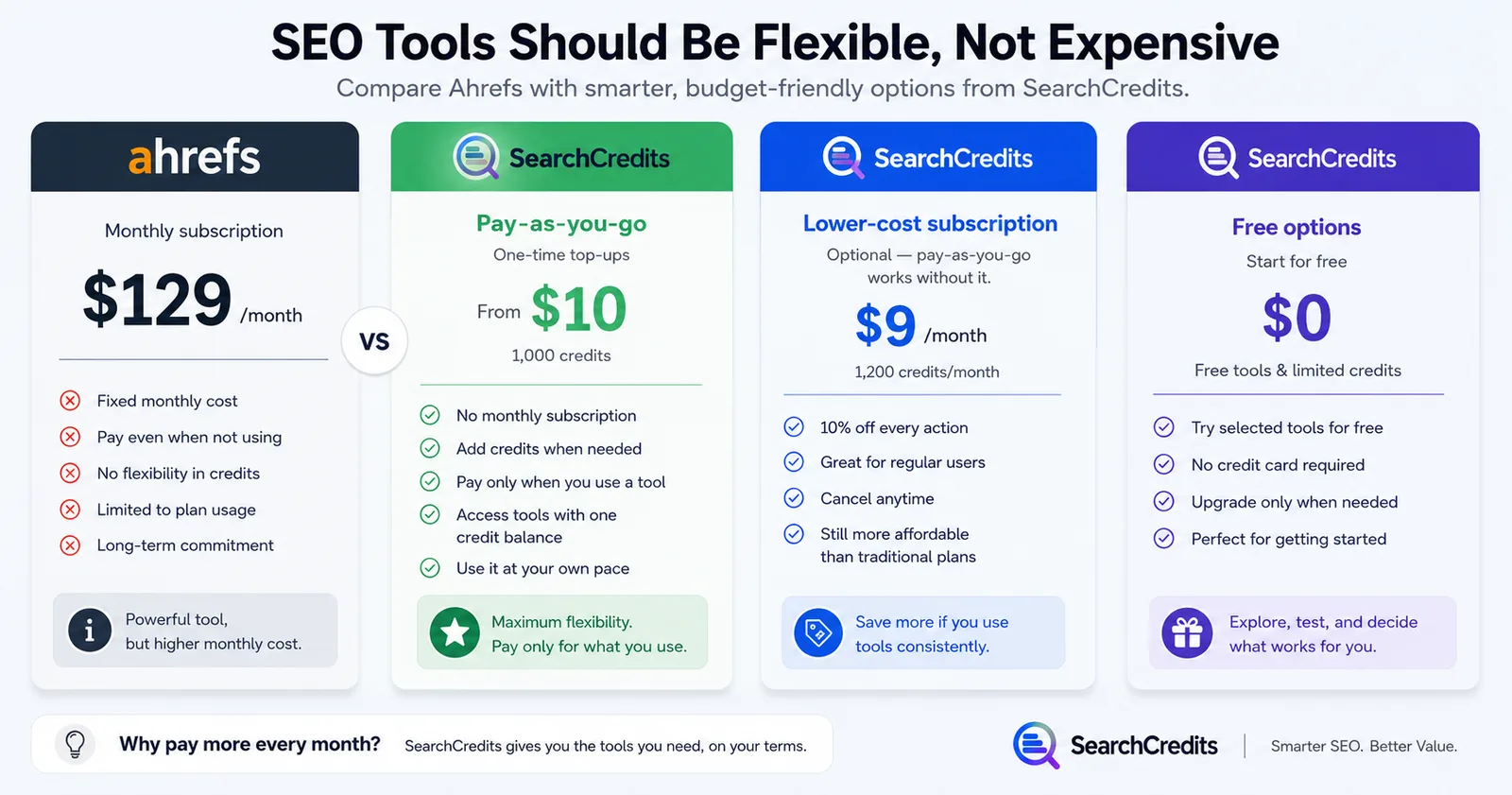
It is pay as you go. One dollar buys 100 credits, and the credit cost of an action is shown before you run it. New accounts receive free signup credits, so you can inspect the workflow before deciding whether to buy more.
Purchased and free credits last for 12 months. There is also an optional $9/month membership that includes 1,200 credits and a 10% discount on every action. Those membership credits are monthly use-or-lose credits, so I would not recommend the membership if you are unlikely to use it consistently.
The available tools cover:
- Keyword research with search volume, keyword difficulty, and related terms
- Single-page and full-site audits
- Scheduled rank tracking for a hand-picked keyword list
- Keyword gap research and top competitor pages
- AI citations and citation-gap analysis
- Shopping visibility
- Price watching
- Local rank grids
SEO data is aggregated from established third-party SEO data providers. SearchCredits is not pretending to be a complete clone of Ahrefs. The point is to answer specific questions without requiring you to keep a large subscription active.
This model makes the most sense for freelancers, small site owners, consultants, and agencies with uneven research workloads. If you run hundreds of checks every day, a conventional subscription may be simpler.
2. Moz Pro: a familiar lower-cost suite
Moz Pro is the closest option here to the traditional “pay monthly and get an SEO platform” model. Its Starter plan is $49/month, while Standard is $99/month.
That makes Starter materially cheaper than Ahrefs’ entry plan, but you should compare limits and included functions rather than comparing price alone. A cheaper plan is not useful if the feature you need sits on a higher tier.
Moz makes sense if you want a recognizable suite structure and predictable monthly billing. It makes less sense if your usage comes in bursts, because you are still paying during quiet periods.
3. Mangools: good when usability matters more than depth
Mangools packages keyword research and SERP analysis in a more approachable interface than many all-in-one platforms. The official pricing page lists Basic at $37.70/month when billed annually.
The annual commitment is the important detail. Do not mentally compare $37.70 with Ahrefs’ monthly price without accounting for the billing term.
Mangools is a sensible choice for bloggers, affiliate site operators, and freelancers who want recurring access without a steep learning curve. You give up some of the breadth and depth associated with a heavier suite, but that may be irrelevant if your regular workflow is mainly keyword discovery and SERP review.
4. LowFruits: focused keyword opportunity research
LowFruits is narrower than Ahrefs, and that is exactly why some people prefer it. It focuses on finding keyword opportunities where weaker sites appear in the search results.
Its official pricing includes $25 for 2,000 pay-as-you-go credits and a $29.90 monthly subscription. The pay-as-you-go option is particularly relevant if you research one content batch, disappear for several weeks, and then return for another.
LowFruits is not the right choice if backlink analysis, technical audits, and broad competitor monitoring are essential. It is a good choice if the immediate question is, “Which realistic keywords should I target next?”
5. Google Keyword Planner: useful, but built for advertisers
Google Keyword Planner can generate keyword ideas and provide planning estimates. It is an official Google Ads tool, so its primary purpose is paid search rather than organic SEO.
That distinction matters. Advertising competition should not be treated as organic ranking difficulty, and the way volume information appears may not match the precision or presentation you expect from a dedicated SEO platform.
Still, it is useful for expanding seed topics, checking commercial language, and understanding how advertisers group related queries. For a zero-cost workflow, it is a strong starting point rather than a complete research process.
6. Google Search Console: the best source for your existing visibility
Google Search Console’s Performance report shows the queries, pages, countries, devices, impressions, clicks, click-through rates, and positions associated with your own search presence.
This is first-party information about your site, which makes it especially useful for content refreshes. Look for queries with impressions but weak clicks, pages sitting within striking distance of stronger positions, and topics where Google already associates your site with relevant searches.
The limitation is equally clear: Search Console does not tell you everything a competitor ranks for, and it cannot reveal demand for topics where your site has no visibility yet.
It works best alongside a discovery tool, not as a replacement for one.
7. Google Trends: best for direction and seasonality
Google Trends lets you compare search terms, examine changes over time, and inspect regional interest.
I use it as a reality check. A keyword tool might return a volume estimate, but Trends can help reveal whether interest is rising, falling, seasonal, or concentrated in a particular market.
Do not read a Trends score as literal monthly search volume. It is a relative measure. Its value is in comparison and direction: which phrasing is gaining interest, when demand peaks, and whether a topic is stable enough to support evergreen content.
What about Semrush?
Semrush is a legitimate Ahrefs competitor, but it is not a cheaper answer at the entry price given here. Its SEO Toolkit starts at $139/month, compared with Ahrefs at $129/month.
That does not make Semrush a bad purchase. It means you should choose it because its specific data, reports, or workflow suit your business—not because you are trying to escape a three-figure subscription.
For more options aimed at independent operators, see my breakdown of SEO tools for freelancers.
How to choose without wasting money
List the SEO actions you completed during the last 60 days. Use actual actions, not ambitious plans.
If the list includes daily competitor checks, backlink analysis, technical monitoring, and ongoing reporting, Ahrefs may be the economical choice because consolidation saves time.
If it includes three keyword batches, one audit, and occasional rank checks, pay-as-you-go tools are easier to justify. If most of your work is updating existing content, Search Console plus Trends may cover more than you expect.
Also account for switching cost. Combining four cheap tools can cost less in cash but more in time. Conversely, paying for a large suite “just in case” is not efficient if you repeatedly use only one report.
Choose around your real workflow, then review the decision after two or three months.
Frequently asked questions
Is there a free Ahrefs alternative?
There is no free tool that reproduces the entire paid Ahrefs platform. Google Keyword Planner, Search Console, and Google Trends can cover keyword ideas, existing search performance, and demand trends. Ahrefs also provides a limited free account, but each free option has clear boundaries.
What is the best Ahrefs alternative for freelancers?
For irregular workloads, a pay-as-you-go option such as SearchCredits or LowFruits can make more sense than another permanent subscription. For recurring client work that needs a conventional suite, Moz Pro Starter or Mangools may be easier to budget.
Is Ahrefs worth $129 per month?
It can be if you use several of its core tools every day. It is harder to justify when you log in only for occasional keyword research or a monthly competitor check.
Can I do keyword research without paying monthly?
Yes. You can combine Google’s free tools with pay-as-you-go research when you need additional volume, difficulty, related-keyword, competitor, or audit data. The trade-off is a less consolidated workflow.
Which alternative is closest to Ahrefs?
Moz Pro and Semrush are closer to the all-in-one subscription model, although feature sets and data differ. Semrush is not cheaper at its listed $139/month entry price. No alternative should be assumed to match Ahrefs report for report.